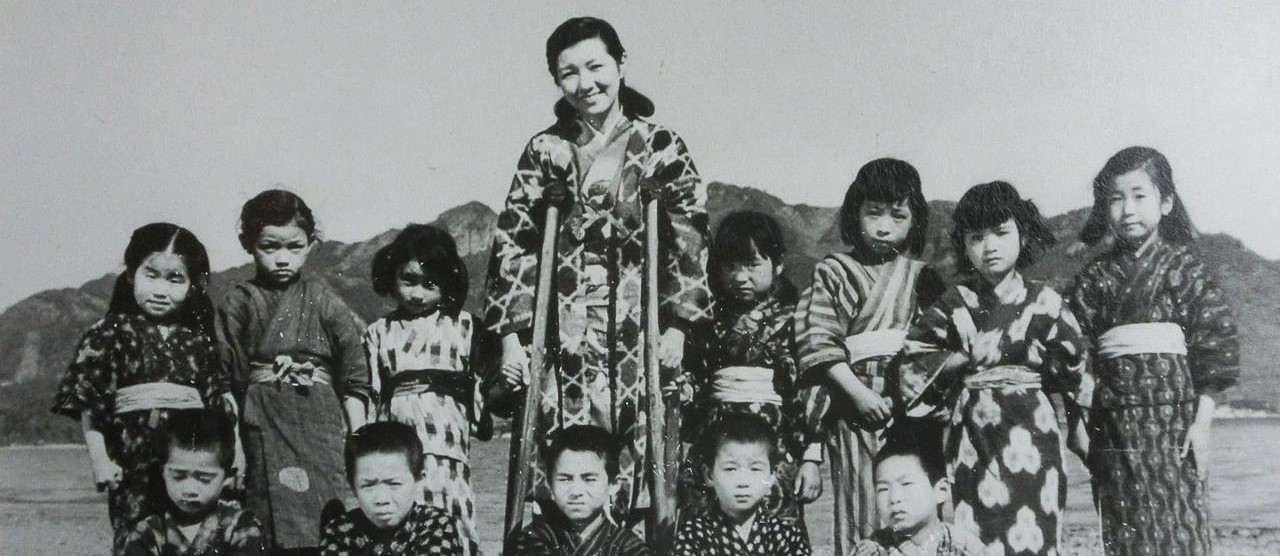
Twenty-Four Eyes starts simply enough. It’s the end of summer, and the young Hisako Oishi is biking into town to embark on the first step of her career as a teacher. Wide-eyed children and skeptical parents alike look on with curiosity at the modern, independent, westernized woman who will serve as their educator for the next year.
Oishi is a good teacher. She speaks to her students on their own level. She shows curiosity about their lives, supports their dreams, and empathizes with their pain. She knows how to handle the bad ones, or the “bullies”, while making the good ones feel even more special and close to her. Ultimately, though, Oishi’s education style is at odds with a mid-century Japan that is hurtling toward a nationalistic war.
As the years pass, Oishi begins to receive criticism from her superiors, peers, and even some of her students. She is called a “Red”. Even though her lessons don’t seem to be motivated by ideology, the way that she is simply interested in the personal well-being of each and every student is enough to mark her with this accusation. At one point, she pushes back on a group of war-hungry sixth-grade boys by telling them she thinks it’s better to be a fisherman than to die for one’s country.
Ultimately, though, Japan continues its march to war, and there is little that single teachers like Oishi can do to stop it. She gives up her job as a teacher to focus instead on raising her own family, and even they look at her with skepticism when she voices anything less than full throated support of the war effort. As the war trudges on, the Japanese army go on to commit various atrocities, before suffering horrifying defeat. Director Keisuke Kinoshita need not spend any time of his film focusing on recounting these horrifying events, which would have been fresh in the mind of his audiences.
Oishi’s husband and some of her students never return from the war. But those that do slowly begin to find themselves sobering from the nightmare of fascism. Eventually, Oishi returns to teaching, and is accepted with great joy by her former students, who have now become the next generation of parents. The film ends on a heartwarming final scene – Oishi, surrounded by her former students, singing and laughing as they recall the old days before the war. They seem, at this point, symbolic of Kinoshita’s own sentiments toward himself and his countrymen: They may have lost their minds and done horrible things under the shadow of fascism, but they were never bad people to begin with. And so they could go always decide to go back.

 The Tingle Review