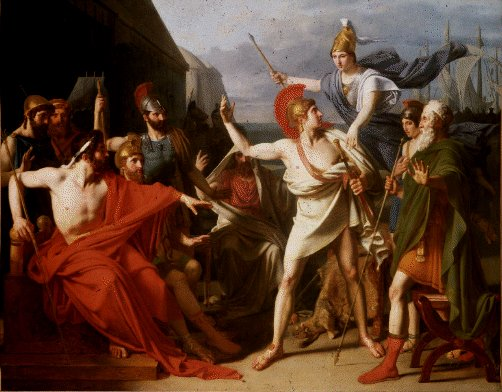
Achilles is an angry man. All of the Greeks (and Trojans) in Homer’s Iliad seem vulnerable to intense bouts of anger, but Achilles loses his cool completely when King Agamemnon takes his captive slave Brisies away. At this point in the story, the Greeks have been in a siege against the city of Troy for months, and while they haven’t broken through the city’s mighty walls yet, all the warriors under King Agamemnon’s leadership have pilfered plenty from the Trojans – gold, animals, women and other slaves, and more. When the god Apollo forces King Agamemnon to return his female captive to her father – one of the god’s own priests – Agamemnon decides to make things right for himself by plucking Achilles’ own Trojan female captive.
Achilles flies into a rage, and refuses to fight for the Greeks. As one of the Greeks best fighters, his absence puts his comrades at a severe disadvantage. Eventually, the Greeks try and return a massive sum of treasures to Achilles to encourage him to fight, but he refuses to accept this. Then, the Trojans kill Achilles’ best friend and comrade, Patroclus. Achilles, hurt more by this than any mistreatment from King Agamemnon, goes on a killing spree, murdering many Trojans, both fighters and innocents alike, including Patroclus’ killer, until the gods themselves must intervene to stop the Greek warrior’s atrocities. Even in a violent world such as Ancient Greece, Achilles, greatest fighter of them all, possesses a threshold for anger and violence that violates propriety and worries even the gods themselves.
Within the text of the epic poem, there are a number of examples of other characters being slighted by their rivals, only to improbably amicable conclusions. Early in the book, for example, two warriors – Greek Diomedes and Trojan Glaucus – duel one another as enemies but bring an end to their fighting in mutual respect. They decide to exchange armor before heading back to their respective camps, akin to players on a football field exchanging their jerseys at the end of a game before heading back to their locker rooms. Somewhat later in the story, after a period of heavy bloodshed, the Trojans offer to pay the Greeks a massive sum – sans their captive, Helen – in order to get the Greeks to leave. The Greeks refuse, but both sides of the conflict agree, at least, to a day-long truce so that each side can properly bury their dead.
A segment toward the end of the poem seems to paint an interesting parallel to Achilles’ outsized violence and uncompromising rage. After Patroclus dies, Achilles plans a funeral for his friend during which he sponsors games of strength and skill. First, Achilles tries to get two Greeks to fight to the death – though the horrified Greek crowd intervenes to end the match before it becomes fatal. In essence, the crowd of Greek onlookers reject Achilles’ violence. Next Achilles also sponsors a chariot race. In this race, the youngest charioteer, Antilochus, controversially uses his own chariot to block an elder charioteer, which causes the elder to place third in the race. Menelaus – the elder – spins into a rage when Antilochus receives the second place prize. The scene looks set for bloodshed when Antilochus apologizes profusely, offering his prize to Menelaus who then – in admiration of the younger man’s honorable accountability – graciously declines the prize.
The interaction between Antilochus and Menelaus seems to contrast sharply with Achilles handling of his own slight. When Achilles’ prize is taken by Agamemnon, Achilles becomes unreasonable and allows his comrades to die fighting the Trojans without his support. Only when Achilles’ own comrade dies does Achilles finally join the fray, and then his bloodlust is nearly unstoppable. Not only does he kill Patroclus’ killer, Hector, but he kills several innocents. Then, he desecrates Hector’s corpse by dragging it on the back of his chariot.
The Greeks look on in concern, and the gods intervene to protect Hector from the dishonor. Eventually, Achilles’ anger softens, when he is made to understand that there are limits to the revenge he can enact, even against the enemy. The world of the Iliad may be a bloody one, where warriors fight to the death, and women and children follow their dead husbands to their graves if they are not lucky enough to be enslaved. But, there are limits to the cruelty that one may be permitted to exact on one’s enemies, difficult though they may be to see. And furthermore, there are moments of humaneness in the Iliad, where characters are celebrated for choosing peace and brotherhood over bloodshed. This ability to overcome one’s own base instincts is demonstrated by men inferior to Achilles, and yet Achilles can not overcome his own not able to overcome his own bottomless wrath until the very end of the epic poem. Thus, even in a world permissive of extreme violence, Achilles stands as a warning against anger and violence taken without limit.

 The Tingle Review