Considering I spent nearly four years of my life listening exclusively to this band and their circle of peers and influences, it’d be a shame if I didn’t write at least a little bit about them, now that they have a self-titled record out. I’m not blown away by the new Dream Theater album, but it’s a very strong late-career outing for a band that have been incredibly productive over the course of their career.
False Awakening Suite: A short piece that has interesting moments but fails to gain much momentum and suffers from a lack of fluidity. It seems to lack purpose. Score: 2/5
The Enemy Inside: An exceptional instrumental section and JP/JR solo spot gives existential validity to this otherwise vanilla prog metal tune. Score: 3/5
The Looking Glass: Dream Theater play to their strengths here moreso than anywhere else on the album, infusing old-school progressive metal with their trademark instrumental craftmanship and LaBrie’s Arena Rock knack for melody. Score: 5/5
Enigma Machine: It’s not as bad as “Raw Dog”, but it lacks direction and fails to mesmerize despite showcasing virtuosity. It might be a lot more fun to watch live. Score: 2/5
The Bigger Picture: This dynamic and powerful song spirals out of control after the first chorus, but that instrumental build-up into the finale puts everything back into perspective. Score: 4/5
Behind the Veil: Parts of good and bad songs are jarbled together without much regard for fluidity. JP’s solo almost saves the song, but we’ve seen that trick too many times before. Score: 2/5
Surrender to Reason: The Rush influences on this album are starting to feel blatant. Dream Theater are obviously lifelong disciples, but even they should know how to avoid those awful 70’s Rush transitions by now. Score: 2/5
Along for the Ride: A solid effort that sits well beside songs like “Wither” and “This is the Life”. Score: 3/5
Illumination Theory: For every fantastic section of this 22 minute song, there is section that feels like a mere formality – including & especially Rush homages. I love the orchestrated section, and the piano/guitar fadeout at the very end. Can we have more of that? Score: 3/5
In sum, things seem looser in DT world this time around. DT12 is a mixed bag that continues to demonstrate that band’s excellent musicianship and creativity, but homages to the band’s influences are too prominent, and the songcrafting is more concise but nowhere near as seamless as on A Dramatic Turn of Events. Overall:6.5/10
If the conclave of Catholic Cardinals is leaving you a little bit cold, you’re not alone. Here are six Iron Maiden tunes to lighten the atmosphere.
1. “The Number of the Beast” from The Number of the Beast (1982)
Here’s the song that started it all. Even though “The Number of the Beast” wasn’t actually promoting evil, the religious right didn’t care and launched a campaign against it anyway, which really just amounted in lots of free press for Iron Maiden. While “The Number of the Beast” isn’t Iron Maiden’s first song or biggest hit, it’s the song that made Maiden a household name.
2. “Heaven Can Wait” from Somewhere in Time (1986)
“Heaven can wait for another day”: That’s a sentiment apparently not only expressed by Iron Maiden bassist Steve Harris, but also a handful of corrupted and greedy Vatican insiders. Hopefully, the conclave and new Pope won’t allow reforming the Church to wait much longer!
3. “Only the Good Die Young” from Seventh Son of a Seventh Son (1988)
The title of Billy Joel’s “not anti-Catholic, but pro-lust” song gets turned on its head here, in Iron Maiden’s indeed anti-Catholic (but also anti-lust) album closer. The song follows The Clairvoyant, a character from the Seventh Son pseudo-concept album, as he expresses frustrations with a hyprocritical religious hierarchy consumed by lust and other deadly sins.
4. “Holy Smoke” from No Prayer for the Dying (1990)
Like “Only the Good Die Young”, “Holy Smoke” is another song poking fun at Church hypocrisy, though this time from the tongue-in-cheek viewpoint of Jesus: “Lot of my friends making me a joke/ mixed up my words like I never spoke!”, or something like that. Hey! Bruce is singing in a flowerbed!
5. “From Here to Eternity” from Fear of the Dark (1992)
A pretty straightforward song about giving into sinful temptations, kinda like “Heaven Can Wait”, but much more shallow. This time, there’s gang vocals, too—had Maiden gone glam? “Hell! Ain’t a bad place. Hell is from here to eternity!”
6. “Judas Be My Guide” from Fear of the Dark (1992)
Maybe one of Maiden’s most underrated songs ever, and definitely one of their most misanthropic. How does one live in a world full of darkness, where everything is for sale and nothing is sacred? Who can one turn to in this Ayn Randian dystopia? Judas, my guide!
Bonus Tracks
If there’s no “holy smoke” by the end of the day, you might need a few more songs to get you through. Here’s a couple more from beyond Maiden’s “classic” era:
1. “The Sign of the Cross” from The X Factor (1995)
Most Iron Maiden fans consider the Blaze Bayley era to be a bit plodding and dull, but “The Sign of the Cross” still gets a little love now and then for its haunting, gothic atmosphere. I’m not sure what this song is about. Is it a genuine call for absolution, or another dark and twisted parody of the Vatican’s shadowy inner machinations? Or is it about “The Name of the Rose”? (The movie version, not the book, obviously).
2. “Montsegur” from Dance of Death (2003)
Only Iron Maiden can make medieval persecution of Gnosticism rock this hard. “As we kill them all so that God knows his own/ the innocents died for the Pope on his throne”, etc, etc. Anyway, great song. Definitely still gets the blood boiling over crimes against humanity committed eons ago.
That’s all for now! I’m sure there are even more Maiden songs that’d be great for the conclave, so feel free to post them in the comments.
The 2012 musical year has now come to a virtual close. In the past I’ve done both write-ups and boring old lists; this year will be a combo: lists with short blurbs. I hope that you like it, and that my list perhaps persuades you, reader, to listen to something you might not have otherwise. Likewise, I’m looking forward to any lists of my friends that get created.
10. Cloudkicker- Fade: Not better than Beacons, but it still manages to capture some of that atmospheric wall-of-sound, and is a welcome return from the new direction introduced by Let Yourself Be Huge.
9. Sithu Aye- Invent the Universe: Really solid, melodic instrumental progressive metal (aka “djent”). Sithu’s got an ear for melody and build-up that lots of his peers just lack. I’m looking forward to future releases, and hopefully they’ll have better sound production, too.
8. Flyleaf- New Horizons: Considering this is the last record with their vocalist, maybe “New Horizons” would have been a better title for their next record. Still, Flyleaf managed to recapture their unique combo of melody and aggression. New Horizons features some incredibly catchy songs, as well as an awesome retooling of an old fan favorite.
7. Alcest- Voyages de L’ame: A very good, atmospheric album that feels tedious at times. While enjoyable, this is probably the last “shoegaze” black metal album Alcest can do before the formula starts feeling too repetitive.
6. Howard Shore- The Hobbit: An Unexpected Journey OST: Unlike many other parts of the Hobbit film, HowardShore’s score is every bit as epic as the original trilogy’s, and features both memorable themes and newer ones that are every bit as good. Thorin’s pensive medieval soundscape and Gandalf’s new, more eccentric theme are brilliant; so are the hints of cacophony that hover over the movements leading us towards Smaug. Shore’s ability to weave heroic themes with chaos is what confirms him—and not Williams or Zimmer or others who always get suggested— as the right composer for scoring Middle-earth.
5. Storm Corrosion- Storm Corrosion: Atmospheric music that is haunting and dark, and every bit as good as Steven Wilson’s Grace for Drowning and Opeth’s Heritage. If this is what Wilson/Adkerfelt is like, I hope this won’t be their only collaboration.
4. Wintersun- Time I: I actually haven’t heard Wintersun before, so I didn’t have any real hopes or expectations going into picking up Time I. I was not, however, disappointed and, needless to say, nor was anyone else. Time I is epic, atmospheric black metal that has a energizing power metal vibe throughout while never sounding too bombastic. Although a shorter work (essentially three longish songs with two instrumental movements sandwiched between), it has gotten no shortage of playtime from my CD player.
3. Katatonia- Dead End Kings: A much more diverse and rewarding album than their last effort, Dead End Kings features both faster songs and more downtrodden, lyrical Katatonia trademarks. “Lethean” might be their best live song. Looking forward to more as I slowly make my way through Katatonia’s back discography.
2. Anathema- Weather Systems: Unlike Anathema’s last album, Weather Systems is more like a song-cycle chock full of recurring motifs and melodic hooks. Weather Systems also distances itself creatively from Steven Wilson enough to cover more than two emotions (sad, and weird).
1. Sigur Rós- Valtari: My favorite album of the year, from what I consider to be the most truly “musical” band around. Valtari offers SR’s trademark combo of post-rock and world music, and is emotionally and thematically consistency throughout. Some fans were disappointed, but I think Valtari has gotten better with every listen. As reflected by its fuzzy, obfuscating creative direction, you need time and patience before you can truly know Valtari, and in turn learn to love it.
It’s inevitable. Soon, people will be catching the Tolkien bug once again, thanks in no small part to this months’ release of The Hobbit: An Unexpected Journey. I, of course, have never successfully cured myself of the Tolkien bug, so thankfully I have the advantage of being able to help you slice through the orcish hoard of dreadfully mediocre The Lord of the Rings licensed stuff that’s out there. Over the next few weeks, I’ll be taking a renewed look at some of the Tolkien-based stuff I’ve read, watched, and played over the years. This post will focus on one of my favorite topics: videogames.
While few Tolkien licensed games are particularly good, playing them might help those finished with The Silmarillion and TheLord of the Rings Appendices realize why sometimes enough really is enough. I’ll start with the better games, and from there move into more lackluster titles.
Lego LotR isn’t just one of the best Tolkien games out there; it’s also one of the best Lego games out there. Lego LotR features a charming and playful take on Tolkien’s Middle-Earth that is one part platformer and one part sandbox RPG. While the game is best enjoyed with friends, it is also a quality product, and its faithfulness to the movies and appropriate incorporation of humor should please fans of Tolkien and plain-old fans of Lego games alike. Though on the lighthearted side, the game also makes an attempt to flesh out some areas of Middle-Earth not included in the movies.
Lego The Lord of the Rings is really best played with friends. Most of the quests require a team effort, and some of them even launch the players into split-screen mode where (for example) Gandalf and Saruman must duel while Frodo and the Hobbits make their simultaneous escape from the Shire.
Unlike other most Lego games, LotR doesn’t feature a single hub of free-play activity. Instead, areas can simply be revisited on a world map after their completion, giving the game all the towns and sidequests associate with classic RPG’s.
All in all, Lego LotR is a fun game, with tons of replay value, and deserves a spot on everyone LotR fan’s gaming shelf.
As far as I’m aware, you’ll need to dust off your Gamecube if you want to play the best and only recent videogame adaptation of The Hobbit out there. Videogame Hobbit is fun and faithful to the original, if not a bit glitchy (unfortunately, it also came out before consoles got patching). While faithful to the book, players will encounter the occasional bizarre fetch-quest or plot arc that simply contradicts Tolkien’s timeline (like when you have to rescue enslaved dwarves from under a mountain. However, if you’d dismissed as being like some of the other trilogy-centered games that came out for the last generation of consoles, you did not do it proper justice. Thankfully, more than a few sellers are letting it go on Amazon for pretty reasonable prices.
While Turbine’s Lord of the Rings Online is without a doubt the most immersive of all Tolkien games, it is also dangerously perilous and can be mentally and financially draining, much like Frodo’s ring-bearer quest.
For the unfamiliar, The Lord of the Rings Online is a Massive Multiplayer Online Role Playing Game (MMORPG) designed around Tolkien’s Middle-Earth. LotRo stays faithful to Tolkien lore, but also takes its players to those Middle-Earth locations far beyond the scope of Tolkien’s popular works, like those rarely discussed northern regions once populated by great kings. For those better initiated with MMORPG standard operating procedure, LotRo is basically The Lord of the Rings themed World of Warcraft.
MMORPG fans will be please to know that LotRo isn’t an all-out WoW ripoff. The game does introduce several new elements to the online role playing game realm, like the ability to wear outfits over armor, and a fairly in-depth music system. On high graphics levels, LotR looks great, making it something that can easily compete with most of the MMORPG competition currently on the market. Furthermore, hardcore fans are bound to be pleased by the lore and role playing emphasis found on many of the game servers. On paper, LotRo is a “dream come true” for fans of both LotR and MMORPG’s. In reality, it suffers from two major shortcomings: wavering activity levels, and a frustrating “pay to progress” style formula.
rock out with other minstrels during festive concert events
The Lord of the Rings Online hooks players with a generous free-to-play system that, for the first 20-30 levels (around 20-30 hrs of gameplay), seems to be all inclusive. There’s a nice mix of “Epic” storyline quests and side quests, which give the player the illusion of a massive, free-to-play world. The problem is, while the storyline quests never end, the side-quests do, which leaves unsubscribed players with a massive—and empty—world to explore, just as they’ve likely grown addicted to the game and attached to their characters.
In theory, players can continue to grind and complete Epic Quests to advance through LotRo’s storyline. In reality, that is too mundane for even the most ardent MMORPG players, and an alternative path must be taken. Turbine offers players several options: Players can subscribe for $9.99 per month, and open up all content included in the original game before the release of expansions, which will take players to level 55 or so. Players can also pay one-time fees to open new locations permanently. Finally, players can grind out in-game “Turbine Points” to open these locations up without paying cash; the only truly free way of playing the game, and by far the most grueling.
That sounds nice, but there’s a really big problem. Turbine’s The Lord of the Rings Online is an ever-dwindling community that relies on increasingly expensive expansion packages to make profits. So, think of it this way: while $10-20 bucks and lots of free time can get you through 50 percent of the game within a few months, getting to the endgame requires you purchase quest packs and expansions beyond the original game content which can cost much, much more. The latest expansion pack, Riders of Rohan, cost around $50 for its cheapest version, and so far Turbine has only taken us halfway to Mordor. In the long run, who knows what it’s going to cost to get your character to Sauron’s Black Gates?.
Riders of Rohan is a nice addition to LotRo… for those willing to pay the price of a new game
Think of it this way: I’d estimate that you can play the first 33 percent of The Lord of the Rings Online for free. You can play the second 33 percent for $10-30 bucks, depending how often you play and how much time you’re willing to put into it. But, the last 33 percent is going to cost you upwards of $100 to finish, and the expansions are only getting more expensive and less expansive as they’re released. You might want to ask yourself from the outset: is it really worth it?
At its early stages, The Lord of the Rings Online is fun and full of life, populated by level 20 freebies who do little outside role playing in Bree’s Prancing Pony. But, from there, LotRo changes into something else; something that reminds me of kids with expensive toys and no-one else to play with. If you’re that kid and love The Lord of the Rings, feel free to buy your own road to Mordor. If you’re not, be prepared to be disappointed when Turbine’s Middle-Earth turns out to be little more than a glorified Facebook game.
The Lord of the Rings: War in the North
Remembergames like Champions of Norath and Baulder’s Gate: Dark Alliance? There were fun games marred by repetitive gameplay and bland story-telling. Well, Snowblind, the creator of those games, is back, and they’ve brought War in the North with them. And surprise! it is a fun game marred by repetitive gameplay and bland story-telling.
Most reviewers scored this game around a 5-6, but I think for Tolkien fans it warrants at least a 7-8. WitN puts you in control of a supplementary fellowship of Man, Elf, and Dwarf as they go on a distraction mission taking out Sauron’s forces in–you guessed it!-the Northern echelon’s of Middle-Earth.
While revering of Tolkien’s work, this game fails to exhibit the necessary imagination and take the necessary creative chances required to truly bring Middle-Earth’s uncharted territories to life. Despite the cool premise, Snowblind’s North is a generic and uninspired land, void of any real LotR magic. Cleaving off goblin heads is fun for awhile, but it does start to get tiresome. So does the story of the game, which uses the same basic formula as the premise for every level. As the player, you’re always looking for someone or something that’s just behind a swarm of enemy cantonments. And, when you beat the level boss and he comes back to life bigger and stronger than ever, the eagles are always there to safe you.
Rinse, wash, repeat. That is War in the North, really.
The Lord of the Rings: Conquest
On the previous generation of gaming consoles, there were a handful of surprisingly good Star Wars games called Battlefront. These games were kinda like third-person shooters, but also a little bit like the Dynasty Warriors series in the sense that they allowed players to take part in epic battles of huge numbers. They were cool because, while they had some issues, they were among the first games bring battles on the massive war scale to consoles.
The Lord of the Rings: Conquest is like Battlefront, only themed around Middle-Earth. Unfortunately, it’s not as good as the Battlefront games.
I’m not sure what the problem is with Conquest, but it’s just not as fun. Part of it, I think, is the emphasis on melee combat: melee was never a strong point of the Battlefront games, but that was OK, since you spent most of your time playing as a rifle-bearing storm trooper or rebel gunner. It was easier to mask lackluster melee combat, because it didn’t happen as much. With Conquest, this isn’t true, and the flaws of melee are put on display.
Another problem is that Battlefront’s mass-scale format just isn’t that impressive on the current generation. Huge, map spanning battles were really cool on the PS2, but they hold no inherent virtue that makes them so on the current generation of consoles. That’s probably why there haven’t really been any battlefront games on the 360 or PS3, and also why Conquest just doesn’t deliver.
***
Well, that’s it for now. The list is by no means complete, but these selections do represent some of the more recent LotR themed games to have come out. Some of these games are good, while others are bad, but most are mediocre in their own ways. If you really want a good fantasy experience on consoles, you’re best bet is just to play Skyrim. It’s the only great game that brings together Men, Elves, and Orcs out there, really. And the new expansion DLC, Dragonborn, is out today.
It’s 9:30 pm Monday night, and Dylan has just taken the stage at Wells Fargo, accompanied by the cacophonous warm-up of his band. Moments earlier Mark Knopfler had encored, offering perhaps his only appeal to the greatest hits crowd in his set for evening. The tone for the night had been set: this was to be a show for true fans and diehards, not for casual fans and listeners desiring a nostalgic experience.
For most of the set, Mark Knopfler played to the aficionado, favoring deep tracks and solo material to radio smashes. Dylan snarled material from all five decades of music, from the appropriate opener of “You Ain’t Going Nowhere” to the always-venerable closer, “Blowing in the Wind”. Whereas Knopfler’s band was always together and aurally well-supplemented by an exemplary auxiliary section featuring a flutist, violinist, and accordionist, Dylan’s was more of a rag-tag crew; fitting, perhaps, considering the large number of selections from Dylan’s breakaway Highway 61 Revisited.
As Mark Knopfler unleashed a sonic storm of Celtic strains and proficient guitar flurries, he made it clear to audience hecklers early that he was not going to be playing “Money for Nothing”. Meanwhile, Dylan pounded on his piano, crooning and growling and snarling through favorites and obscure cuts alike, much to the surprise of some unseasoned audience members doubtless expecting to see their 60’s idol appear clad saintly in suede boots, dark shades with a harmonica around his neck, unworn by time and harsh reality.
Despite physical limitations, Dylan appeared genuinely well-spirited, especially on the harmonica and piano during extended jams and on special occasions, such as when he stepped away from the piano to deliver an absolutely stunning and terrible rendition of “Ballad of a Thin Man”. As Dylan’s set progressed, there were some who giggled through the performer’s crooning, while there were others who left early or stayed involuntarily, spending the rest of evening drinking $13 beers while browsing Facebook on their iPhones. But, by the final song of the evening, all but the true believers had filed out, and Dylan received a strong standing ovation from an arena of true believers.
Those who left the arena early ought to be disappointed with themselves for turning their backs on a legend. But, they probably would have been disappointed with Dylan anyway, even if the performance were given by a Dylan in prime health.
They probably wanted Dylan to sing something pretty for them.
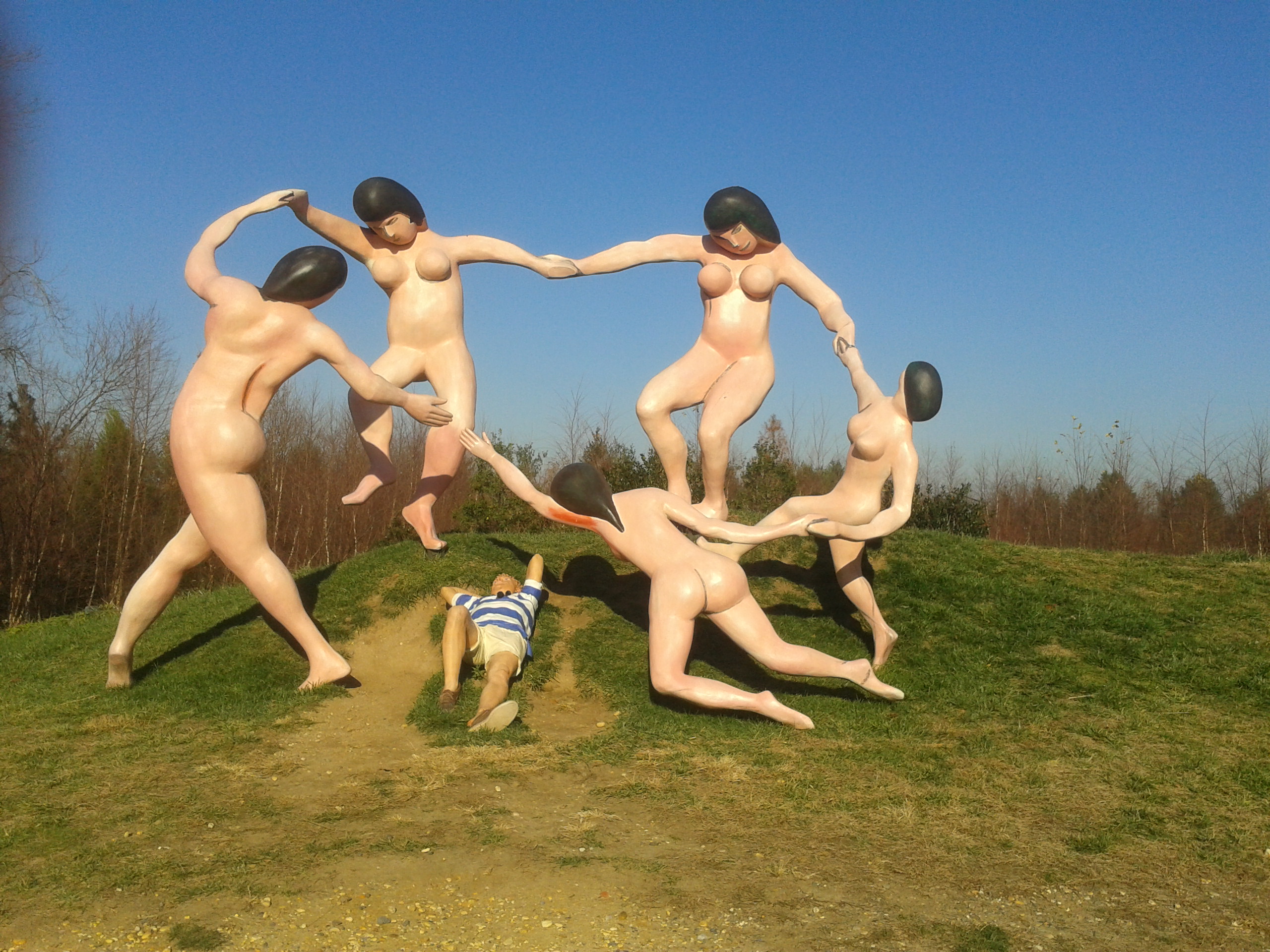
Having taken the NJ Transit from Hamilton station up to Newark and New York City several times, I’ve always been fascinated by the larger-than-life sculptures surrounding the area. From the mariachi singers that welcome visitors at the train station parking lot, to the couple pointing up at the large tooth across the street, and the odd, scaled-looking horse and rider that can been seen from the transit train window on rides to Trenton, I’ve always had curious fantasies about the Hamilton area and it’s weird monuments.
Apparently, the source of the sculptures is no real mystery. The source is that they come from Hamilton’s Grounds for Sculpture, a initiative beginning in 1992 designed to promote greater appreciation of sculpture as art. The park’s 42 acres are dotted with various sculptures and other works of contemporary art, including my favorite: a series of diorama’s themed around Dante’s Inferno by Robert Taplin.
the meadow is home to some of the grounds’ more bizarre sculpture
Sculptures in the park cover a wide variety of themes and aesthetics. A newer area called “The Meadow” contains mostly darker, most bizarre sculptures while outdoor ones tend to focus on the more traditional; people, and places. Aside from sculptures, there’s also a decent cafe on the grounds, as well as a more expensive, high-class restaurant. This makes Grounds for Sculpture the perfect place for a date or day out, but also a potential destination for school trips. After all, the goal of the grounds is to promote education of the arts.
as a park plaque warns, some of the,more mature art may “challenge” younger visitors
Many of the sculptures are fascinating. A few are baffling. But all are, at least, interesting. All in all, Grounds for Sculpture is a great place to take a break and appreciate art, and maybe even muster up a little of your own creative inspiration. I came away from the grounds with not only a deeper appreciation of outdoor sculpture, but also with a wish that there were more places like it around. Art often comes under attack by narrow-minded people, but when we take the time to appreciate art in a comfortable and relaxing setting, we often find that we’re all capable of appreciating it.
The magic strains of Howard Shore’s The Lord of the Ringstrilogy soundtrack remain some of the most enduring ever, right up there with Star Warsand The Godfather in terms of recognition and enduring value. It’s hard to listen to Shore’s Shire theme, or Rohan’s war anthem, or Enya’s “May it Be“, and not immediately be transported back to the mythic realm of Middle Earth and its various, larger-than-life locales.
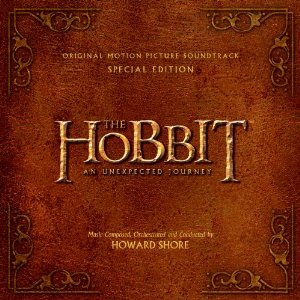
After viewing the first two The Hobbit trailers, I was a little bit concerned. So much of Howard Shore’s music sounded new, without so much in common with Shore’s LotR masterpiece. Fortunately, the new Hobbit soundtrack dispels all doubts quicker than Gandalf’s exorcist of Saruman-possessed Theoden King. While The Hobbit OST contains the appropriate amount of references to the previous trilogy, Shore flawlessly weaves in a number of new and interesting themes which, I suspect, will become just as enduring as their LotR counterparts. Among the highlights are Richard Armitage’s drawven “Misty Mountains” dirge, based on Tolkien’s own poem bound to become the central theme of the series. Listen to the soundtrack yourself by clicking on the image below:
“Facebook wants YOU to vote in tonight’s election!”
As election night draws on, I’m sitting on my laptop. I flick back and forth between MSNBC and CNN while refreshing RealClearPolitics every five minutes. I’m waiting for 11 pm, when Stewart and Colbert begin their hilarious annual coverage. In the meantime, I’m browsing Facebook, too. Hurrah for multitasking.
Facebook on election night is exactly what you’d imagine it to be. One out of every three statuses to reach my newsfeed is something about the election. Out of these election statuses, a considerable number of them can be filed into the category of smarmy, sarcastic mockery; statuses like “insert political opinion here” and “UGH, I’m tired of hearing about election crap on Facebook!”
Statuses of that variety are interesting to me, because it seems like every time something is trending on Facebook or Twitter, there’s someone out there who wants to make sure you know that they don’t care. This doesn’t just happen on election night; this happens before hurricanes, and when breaking news comes out, and even over the holidays. And, this begs the question: if someone really doesn’t give a damn about what Facebook is talking about, and is even annoyed about what they’re seeing on their Facebook newsfeeds, then why is that person still spending so much time hanging out on Facebook?
I’m thinking the internet, and Facebook, is like some kind of addictive substance. When I’m annoyed by something in real life, I have no problem keeping quiet and removing myself from the situation. But, that seems harder to do on Facebook, or anywhere online. That might be because the internet makes people courageous: when physical confrontation is taken out of the equation, it’s easy for anyone to suddenly become a loudmouth. It might also be because of the nature of Facebook and the internet itself. The internet is a place for clicking things, opening new taps and refreshing old ones. When I boot up Chrome, I automatically open up several tabs to accommodate my favorite sites. It’s automatic, formed gradually by habit.
Maybe it’s also because Facebook and other internet discussion mediums have become such a major arena of discussion in our personal lives. I vent on Facebook. I make plans on it, too. I know people who’ve began and ended their relationships using Facebook. I know lots of people who don’t know what’d they’d do if there was no Facebook. And, just about everyone I know is stuck on Facebook, for better or worse, despite concerns over their own internet habits and reservations about the company’s stance on user privacy. We just can’t remove ourselves from Facebook, and we can’t imagine a world where Facebook removes itself from us. We’re stuck with it.
Cloud Atlas is a movie unparalleled in scope. Wowing you in ways that only a premier Wachowski brothers film can, I suspect that Cloud Atlas would already be hailed as an instant classic were it not for the demanding length and intellectual difficulty of the film.
I’m not going to go too much into how Cloud Atlas has blazed new trails in cinema; the project was unquestionable in its ambition, and, like Peter Jackson’s Lord of the Rings trilogy, proves once again that film can be a proper medium to tell the types of stories that critics are always claiming to be impossible; others have written extensively about that. I’m not gonna bother answering valid criticisms about how some of the movie’s various story lines would be bland on their own; that’s beyond the point of the entire movie.
Really, I just want to say that, while Cloud Atlas is a science-fiction movie, detective story, fantasy novel, romance, comedy, and drama rolled up into one, its focus is pretty straightforward: it’s a movie about what makes movies good–being, a story where compelling, human characters are forced to rise above various obstacles and societal barriers. In a way, Cloud Atlas is a movie about why we like movies. And, if you like movies, you deserve to at least give something as ambitious as Cloud Atlas a honest try.
Oh, and Tom Hanks and Halle Berry are great, as is the rest of the cast. I definitely have got to start talking like those “After the Fall” people.
A little while ago, I finally finished Patrick Rothuss’ The Name of the Wind, after giving it a second chance. My second attempt, though much more enjoyable than my first (I actually finished with it, instead of just getting 10 percent through), still urged me to immediately post the following blurb on Amazon from my Kindle:
Narrated in the first person by Kvothe (pronounced quothe), The Name of the Wind is a smug, self-congratulatory account of how a self-righteous brat manages to get his way again and again thanks to luck and Rothfuss’s half-convincing displays of his main character’s cleverness. Mostly good prose and background story earns this novel two stars, but Rothfuss’s setting would be much better not see through the lens of Kvothe’s narration, which is like listening to a compulsive liar try and make up for obvious self-esteem issues.
In all honesty, though, it’s a wonder that the novel isn’t worse than it is; it breaks all the unwritten rules of writing a good story. The story, at first, is told in the third-person present, but soon the action devolves into long stretches of past-tense narration, in the form of protagonist Kvothe telling his story to a chronicler named… Chronicler. Kvothe is arrogant and self-absorbed, and neither he nor any of the other characters display any relevant level of personal growth or development, which is a real shame considering the various trials they go through together.
The Name of the Wind is often described as a novel for Harry Potter fans wanting more. While I’m not huge HP fan, I couldn’t help but find some irony in the fact that this novel made me want to return to Hogwarts. The best parts are, without a doubt, when Kvothe is living at the magic University, getting along with his various peers. But even Rowling approaches her own characters with more of a critical eye. Harry becomes a whiny jerk by his teens, but Rowling, unlike Rothfuss, never gives you the impression that Harry’s commendable for being so. Kvothe, in contrast, loves victimizing himself, even when the trouble he gets himself in is well-deserved and long overdue. And Rothfuss expects you to feel good about it, when Kvothe’s cleverness grants him another free pass.
Lots of people like The Name of the Wind. Lots of people also like the idea that they’re always right, and the other guys is always wrong, and any bad things that happen are obviously someone else’s fault.


 Lego LotR isn’t just one of the best Tolkien games out there; it’s also one of the best Lego games out there. Lego LotR features a charming and playful take on Tolkien’s Middle-Earth that is one part platformer and one part sandbox RPG. While the game is best enjoyed with friends, it is also a quality product, and its faithfulness to the movies and appropriate incorporation of humor should please fans of Tolkien and plain-old fans of Lego games alike. Though on the lighthearted side, the game also makes an attempt to flesh out some areas of Middle-Earth not included in the movies.

 Remembergames like Champions of Norath and Baulder’s Gate: Dark Alliance? There were fun games marred by repetitive gameplay and bland story-telling. Well, Snowblind, the creator of those games, is back, and they’ve brought War in the North with them. And surprise! it is a fun game marred by repetitive gameplay and bland story-telling.
 On the previous generation of gaming consoles, there were a handful of surprisingly good Star Wars games called Battlefront. These games were kinda like third-person shooters, but also a little bit like the Dynasty Warriors series in the sense that they allowed players to take part in epic battles of huge numbers. They were cool because, while they had some issues, they were among the first games bring battles on the massive war scale to consoles.



 A little while ago, I finally finished Patrick Rothuss’ The Name of the Wind, after giving it a second chance. My second attempt, though much more enjoyable than my first (I actually finished with it, instead of just getting 10 percent through), still urged me to immediately post the following blurb on Amazon from my Kindle:
 The Tingle Review